
A Breakthrough in Ocean Energy and Sustainability
What Is the Man-Made Ocean Upwelling System?
Our patented (pending) system uses a large underwater airfoil—shaped like a wing—that “flies” in a figure-eight pattern in the powerful Gulf Stream current. This wing system can be configured in three different ways, each designed to help solve critical global challenges like food security, carbon capture, and renewable energy production.THREE INNOVATIVE CONFIGURATIONS
1. Ocean Fertilizer System (Water Pump on the Airfoil)- The underwater airfoil carries one or two propellers connected to high-volume water pumps.
- As the wing flies through the current, it pumps nutrient-rich deep ocean water (from over 1,000 feet) to the surface.
- These nutrients supercharge the upper ocean layers, stimulating phytoplankton growth, which forms the base of the marine food chain and absorbs large amounts of CO₂.
- Impact: Increases ocean biomass, seafood supply, and carbon capture.
2. Hybrid System (Electric Generator on the Airfoil)
- The propellers on the flying wing drive an electric generator instead of a water pump.
- Electricity is sent down the tether to the anchor-mounted pump on the ocean floor.
- That pump then pushes cold, nutrient-rich water to the surface through a large-diameter hose.
- Why this matters: This setup reduces drag and makes it easier for the airfoil to maneuver in figure-eight patterns while still achieving full ocean fertilization benefits.
3. Pure Energy System (Power to Shore)
- The propellers on the airfoil drive an electric generator.
- Electricity is transmitted down the tether and through a seabed cable to the shore.
- This system generates up to 4 megawatts (MW) continuously—enough to power over 3,000 homes—with no dependence on wind or sunlight.
- Benefit: A 24/7 clean energy solution powered only by ocean currents.
The Man-Made Ocean Upwelling System uses an underwater “kite” — a tethered, wing-shaped hydrofoil — that flies in a controlled figure-8 pattern inside the Gulf Stream. Instead of just sitting in the current, the wing actively flies through it, greatly increasing the speed of water flowing across the propeller and, in turn, the amount of power we can harvest.
Basic Principle
- The underwater airfoil is attached to a tensioned tether anchored to the seafloor or a neutrally buoyant hub.
- The Gulf Stream itself moves at roughly 5–6 mph (about 2.2–2.7 m/s), but the wing is not limited to drifting at that speed.
- Because it acts like a submerged airplane wing, it can “fly” across the current, not just with it, just like a sport kite flying in the wind.
By steering the wing dynamically, we can make it travel many times faster than the surrounding current, multiplying the water velocity across the propeller.
Why the Figure-8 Motion Multiplies Power
The kite doesn’t just trace a circle; it follows a tight figure-8 path across the flow:
-
Lift-Based Propulsion
- As water flows over the wing, it generates lift (just like an airplane wing, but in water).
- By setting the wing at the right angle of attack, that lift pulls it sideways through the current, not merely downstream.
-
Controlled Steering
- Small control surfaces (flaps, rudders, or elevators) on the wing, or adjustments at the tether connection, steer the kite.
- An onboard control system continually adjusts these surfaces so the wing weaves back and forth in a repeatable figure-8 pattern.
-
Tether Tension and Flight Envelope
- The tether is kept under high tension, so the kite “flies” within a cone of motion defined by tether length and anchor point.
- Within that cone, the control system keeps the kite in the parts of its path where cross-current speed is highest.
Because the wing is flying through the current rather than just sitting in it, its speed relative to the water can reach several times the speed of the Gulf Stream itself.
That matters because:
The energy in moving water is proportional to the cube of velocity.
Doubling the speed yields up to 8× the power.
Increasing speed several-fold yields orders of magnitude more power than a stationary propeller.
From Wing Motion to Electric Power
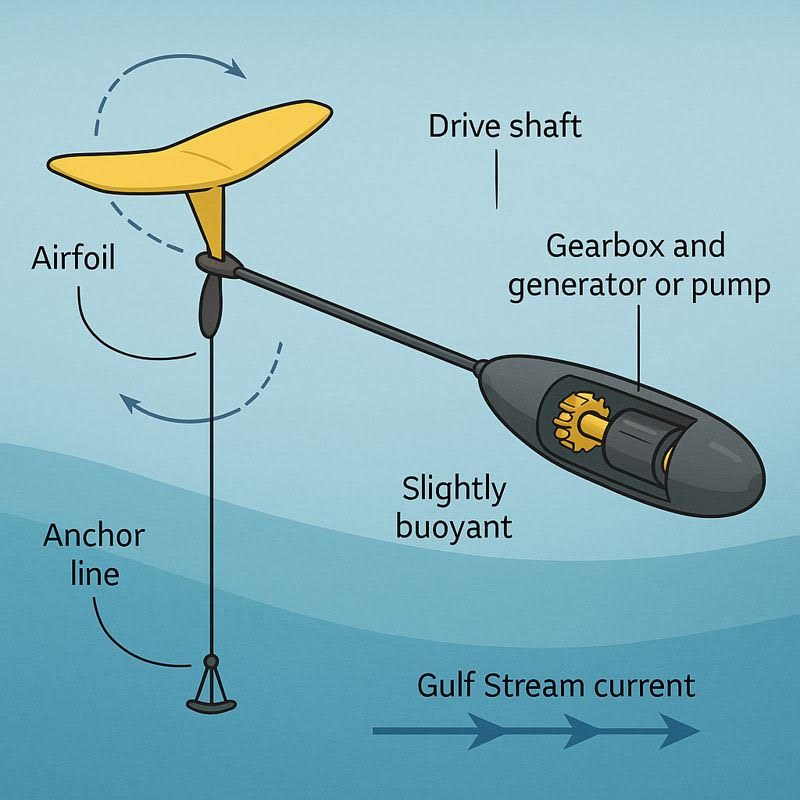
- A propeller is mounted beneath the wing and spins in the accelerated flow created by the wing’s high-speed figure-8 motion.
- The propeller drives a long, streamlined driveshaft with universal joints that extends downstream.
- At the end of this shaft is a separate, torpedo-shaped pod (similar in shape to a V-2 rocket or small submarine) that contains:
- A gearbox
- An electric generator (for the pure-energy configuration)
Separating the heavy equipment into this downstream pod keeps the wing itself:
- Lighter and more maneuverable
- Lower drag, so it can fly faster
- More efficient at converting the Gulf Stream’s kinetic energy into useful mechanical and electrical power
Scaling to Multi-Megawatt Output
The same basic architecture can be scaled by adjusting:
- Wing area (wingspan and chord length)
- Propeller diameter
- Operating depth and local current speed
- Number of units deployed in the Gulf Stream corridor
With optimized wing and propeller sizing, a single system can produce continuous, multi-megawatt power from the Gulf Stream, 24/7, with no dependence on wind or sunlight. This is the core of the Gulf Stream electric generation configuration of the Man-Made Ocean Upwelling System.
WHY THE SYSTEM WORKS
- Lift from Water: Water is 833 times denser than air. This means the propellers on the airfoil extract far more power from water than an equivalent wind turbine can from air.
- Velocity Multiplier: The wing flies at 4 to 6 times the speed of the ocean current, dramatically increasing the energy harvested, thanks to the cubic relationship of speed to power output.
- Efficient Water Pumping: At 1,000 feet depth, internal and external water pressure are nearly equal. The pump only needs to overcome a small pressure difference—0.002% of atmospheric pressure—making it easy to move massive amounts of water with very little energy.
This improvement separates the propulsion and energy conversion components of the system to dramatically reduce hydrodynamic drag and enhance performance.
- Airfoil Configuration:
- The underwater airfoil remains tethered to the ocean floor and flies in a figure-8 pattern within the Gulf Stream current.
- A single propeller is mounted directly beneath the centerline of the airfoil.
- The airfoil structure is slightly buoyant.
- Remote Driveshaft System:
- A long driveshaft with universal joints extends downstream from the propeller shaft, transferring mechanical energy away from the airfoil.
- The driveshaft pulls a separate, streamlined buoyant pod located downstream in the flow.
- Downstream Power or Pumping Pod:
- The downstream pod is shaped like a WWII V2 rocket or mini-submarine to minimize drag.
- It houses a gearbox and either:
- An electrical generator (for renewable energy applications), or
- A high-capacity water pump (for upwelling nutrients).
- The pod is slightly buoyant and held in place downstream by the natural flow of the Gulf Stream,
Advantages of This Configuration:
- Lower Drag on the Airfoil:
- Heavy components (generator/pump) are offloaded to the downstream pod, reducing resistance on the figure-8 path of the airfoil.
- Improved Efficiency:
- The airfoil can move more easily and faster, increasing propeller speed and energy capture.
- Modular Flexibility:
- The same system supports both electric power generation and nutrient-rich water pumping, depending on the payload in the downstream pod.
- Mechanical Isolation:
- Universal joints in the driveshaft accommodate the complex movement of the airfoil while maintaining power transmission to the fixed-load pod.
THE SCIENCE OF DEEP OCEAN WATER
Deep water contains vastly more nutrients than surface water:- Nitrate: 50–100× more than surface water
- Phosphate: 20–50× more
- Silicate, CO₂, Trace Minerals: All essential to marine life and photosynthesis
Bringing this water to the surface:
- Triggers algae and phytoplankton blooms
- Supports fish, whales, and marine biodiversity
- Absorbs carbon dioxide at massive scale
WHY THIS MATTERS
More Food, More Oxygen- 20% of ocean upwelling zones produce over 50% of the world’s seafood.
- One square foot of properly fertilized ocean can grow 10× more biomass than the same area of land.
Carbon Capture & Climate Stability
- Phytoplankton remove CO₂ and generate oxygen—more than 70% of Earth’s oxygen comes from the ocean.
- Cooler deep water on the surface may help reduce hurricane intensity.
Deployment & Operation
- A vessel installs the system in the Gulf Stream.
- The airfoil is anchored deep underwater.
- The system operates autonomously, with no fuel, no solar panels, and no wind dependency.
- Minimal maintenance and scalable deployment.
THE BIG PICTURE
This technology:- Captures CO₂
- Boosts seafood supply
- Restores marine ecosystems
- Generates clean electricity
- Operates continuously, even in rough conditions
- Costs far less than most climate and energy solutions
JOIN THE MISSION
We’re ready for large-scale deployment. If you’re an investor, policymaker, environmental group, or scientist—we want to talk to you.
WATCH OUR SIX-MINUTE VIDEO